Religions are often seen as old, slow, and stuck in the past. Technology feels fast, shiny, and always new. So how do they even talk to each other?
I want to walk you through five very different religious worlds and show you something simple but surprising: none of them are just “for” or “against” technology. They all ask a deeper question: What does this tool do to the kind of person I am becoming?
Let’s go one by one and keep it very clear and practical. As you read, ask yourself: which of these attitudes feels closest to how you relate to your phone, your apps, and your online life?
“We shape our tools and thereafter our tools shape us.”
— Marshall McLuhan
Have you ever stopped and asked: what is my phone shaping in me right now—patience or impatience, kindness or envy?
Buddhist teachers usually do not start with “Is this technology good or bad?” but with “What is this doing to my mind?”
In simple terms, Buddhism cares a lot about what you pay attention to and why. That is what I mean by mindful engagement. If a tool pulls your attention into stress, comparison, and craving, that is a problem. If it helps you notice your breath, calm down, and act with kindness, it can be helpful. Same phone. Different use.
So we see meditation apps that let people practice for ten minutes in a bus or during a lunch break. That is very new in form, but very old in spirit. A Buddhist might say: if you can remember your breath in a noisy subway thanks to an app, that is not a betrayal of tradition. That is tradition doing its job.
At the same time, many Buddhist teachers warn that social media can work like a factory of craving. Likes, comments, endless scrolling—these feed the same habits that ancient texts warn about: wanting more, comparing, chasing images, building a fake “self” to show others.
Here is a question you can ask yourself in a very simple way: “When I stop scrolling, do I feel more peaceful or more restless?”
That one question is more important in Buddhism than any question about whether a new gadget is “modern” or “traditional.” The focus is on what it does to your heart and mind.
A less obvious point is that some Buddhist groups are using digital tools to spread teachings to places that never had local teachers before. A monk in one country can guide a meditation group across the world over a video call. That would have been impossible a few decades ago. But even here, thoughtful teachers often set limits: no phones in the meditation hall, or silent times with all devices off, so that people still get to taste real stillness without constant pings.
In short, the Buddhist question is simple: This tool is here. How do I use it without becoming its servant?
“The mind is everything. What you think you become.”
— often attributed to the Buddha
So when you use a device, what kind of “you” is it slowly building?
Now let’s look at a very different world: Islamic law, or fiqh. Here, people do not only ask personal questions like “Is this good for my attention?” They also ask legal and moral questions: “Is this allowed? Is this fair? Is this harmful?”
In Islam, there is a long tradition of scholars applying old principles to new situations. Today, those situations include online banking, digital currencies, trading apps, prayer-time apps, and even ideas like “virtual Hajj” tours.
For example, Islamic finance tries to avoid unfair risk, interest-based lending, and cheating. When new money tools appear—crypto, online day trading, complex digital contracts—scholars debate: does this count as fair trade or as gambling? Is this clear and honest, or tricky and misleading?
The key idea is not “new is bad.” The key idea is: “Does this new thing fit with justice, honesty, and care for the weak?”
Prayer apps are another side. You have apps that show the direction of Mecca, send reminders for prayer times, and stream sermons. Many scholars support these, because they help people pray on time and stay connected. But they also warn that pushing worship into the “reminder notification” space can make faith feel like just another app competing with games and social media.
A sharp, modern example is the question of “virtual Hajj.” With VR, you can “walk” around a 3D Kaaba. Some people see this as a helpful learning tool. But most scholars hold a simple line: the real pilgrimage is physical, with real bodies and real effort. A headset can teach you, but it cannot replace the real act.
Here is a simple question many Muslim scholars ask about any new digital thing: “Does this bring people closer together in real care and responsibility, or does it isolate them and harm the weak?”
“Actions are judged by intentions.”
— Prophetic saying often quoted in Islamic discussions
With digital tech, the intention is not only in the heart of the user. It is also in how the tool is designed. Does it push you toward greed, addiction, and showing off? Or does it support honesty and service?
Now think about a group that often gets mentioned as “anti-tech”: the Amish. Many people say, “They hate technology.” That is wrong and too simple.
The Amish do use technology. The key is that they say “yes” or “no” very slowly, and they say it together as a community. They ask one question over and over: “Will this tool harm our family life, our faith, or our ability to help each other?”
So you may see an Amish sawmill powered by a diesel engine—because it helps with work—but no TV in the house, because it pulls people away from meals, prayer, and face-to-face talk. They may allow a phone in a small wooden shed at the edge of the property, shared by several families, but not in the kitchen. That way, the phone is there for real needs, but it does not break every quiet moment with constant ringing.
Have you ever wished you could put your own phone in a “shed” like that—near enough to use when needed, far enough that it doesn’t rule your evening?
One interesting detail is that Amish communities are not all the same. Different groups draw the line in different places. Some allow filtered mobile phones for business only. Some allow certain kinds of solar panels. But the logic is always the same: slow testing, lots of discussion, clear limits.
What looks from the outside like “refusing progress” is, inside, more like protecting a way of life they see as more valuable than constant convenience. They are less afraid of looking old-fashioned than of losing strong family bonds.
You and I may never join an Amish church. But we can still learn something simple from them: it is okay to say “This tool is useful at work, but it has no place at my dinner table.”
“The things you own end up owning you.”
— Chuck Palahniuk
If that can be true with clothes and cars, how much more with screens and apps?
Now to Hindu life in a digital world. Here the picture looks very different again.
In many Hindu communities, technology is used to stretch the reach of devotion. You see live-streamed temple rituals, priests doing online ceremonies for families who live far away, mantra apps that help people chant while commuting, and digital calendars for festival dates.
There is a simple idea under this: the sacred is not tied to one place or one tool. If the heart is sincere, God can be remembered through a lamp on your altar or through a video on your phone.
Have you ever joined a festival online, maybe watching a city you love on a stream? For many Hindus abroad, that is how they stay tied to the sounds and sights of home temples. The physical crowd is still ideal, but the stream holds them in the circle in a new way.
At the same time, there are worries. When puja is ordered like food delivery, does it turn worship into a product? When people watch rituals like shows, do they become spectators instead of participants?
Some priests try to solve this by guiding people step by step during online rituals: “Light a small lamp in your own home now. Repeat this line. Offer water now.” The screen becomes a bridge, not just a window.
One subtle benefit is that digital tools can help preserve languages, chants, and songs. Young people who might not learn from a local elder can now hear old melodies in high quality on their phones. A tradition that lives through sound adapts very well to a world of recordings and streams—if people use them with care instead of just playing them in the background.
So the Hindu story is not just “ancient tradition meets modern tech.” It is more like “a flexible tradition uses new tools to keep devotion alive across long distances.”
“Wherever you go, there you are.”
— Jon Kabat-Zinn
You can be in a temple with your mind on your phone, or on a phone with your mind fully on God. The place matters less than the attention you bring.
Now let’s step into Christian monastic life. Imagine a community that has practiced silence, fasting, and strict daily rhythms for over a thousand years. Then add the internet.
For many monks and nuns, the internet is not simply “information.” It is closer to a powerful food that is easy to overeat. So they treat it the same way they treat rich meals—by rules and limits.
Some monasteries allow WiFi only in one room, at certain times. Some have a single shared computer. Emails and news are checked on fixed days. Personal devices may be banned inside private rooms.
Have you ever tried a “phone-free Sunday” or an evening with your data off? Monastic communities are doing this on purpose, not because they fear tech, but because they know their attention is precious.
They see digital fasting as a new kind of old practice. In the past, a monk might fast from meat, speech, or sleep for spiritual reasons. Today, they may fast from screens. The goal is the same: to remember that you are not a slave to your appetites, even very modern ones.
Some monasteries also help visitors taste this. They offer retreats where guests hand in their phones at the gate. Many people are shocked at how strange the first hours feel—and how peaceful the second day feels.
There is a small but very important insight here: most of us are not choosing our use of technology; we are drifting with it. Monks try, however imperfectly, to choose.
“Be still, and know that I am God.”
— Psalm 46:10
Stillness is hard when your pocket buzzes every few minutes. Monastic rules about digital tools are simply ways of creating space for that stillness.
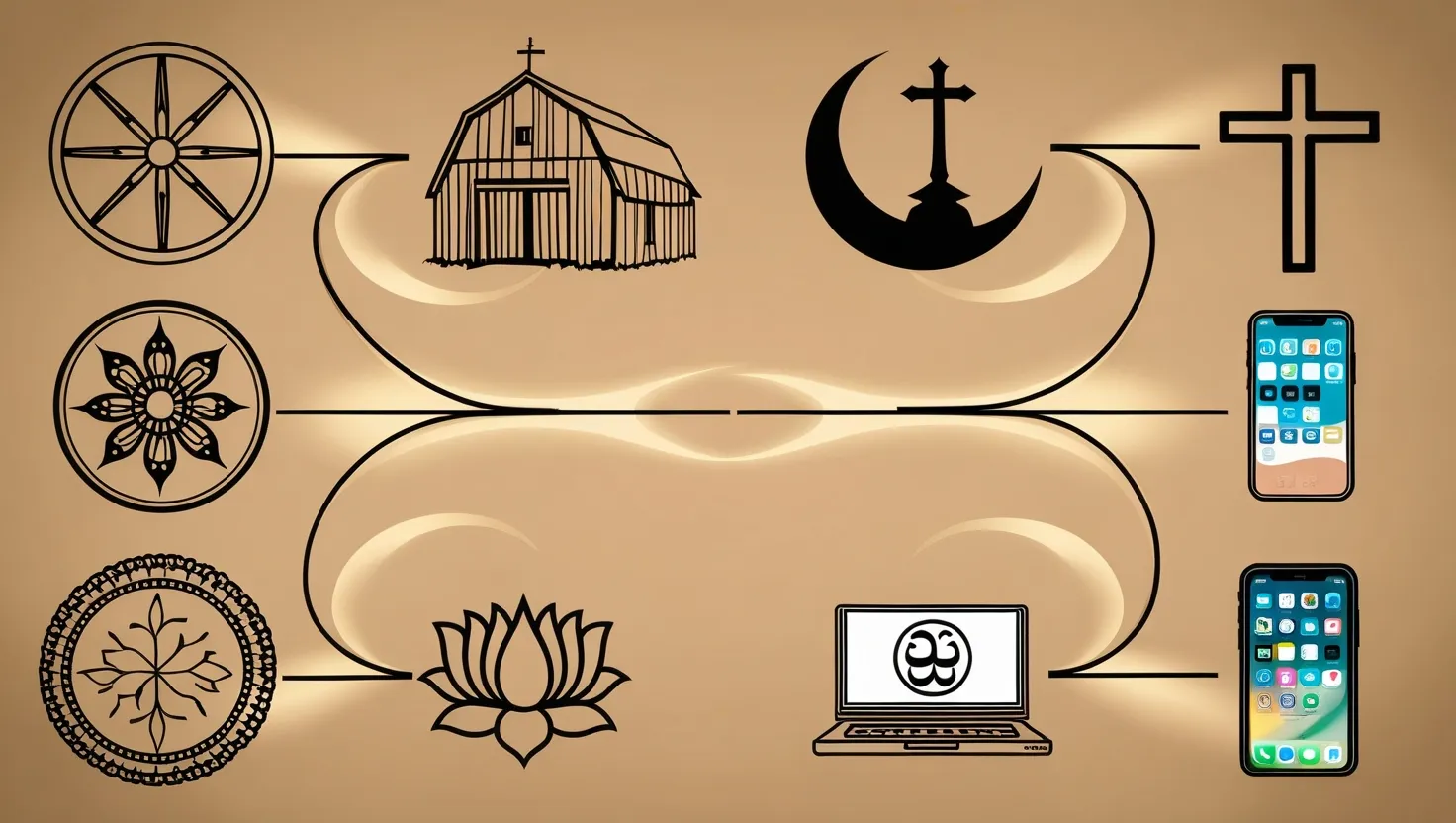
So what do these five traditions show us when we look at them side by side?
Buddhist mindful use asks: “What is this doing to my attention right now?”
Islamic legal thinking asks: “Is this fair, just, and in line with our duties to God and each other?”
Amish selective use asks: “Will this tool hurt our family, our faith, or our way of helping each other?”
Hindu digital devotion asks: “How can we keep our bond to the divine and to each other, even across distance, using these new tools?”
Christian monastic restraint asks: “How can we keep room for silence, prayer, and real presence in a very loud world?”
Now I want to turn this back to you in the simplest way.
Which of these questions do you need most in your life right now?
Do you need the Buddhist pause: “Is this scroll making me more kind or more anxious?”
Do you need the Islamic check: “Is the way I use money online honest and fair?”
Do you need the Amish courage to say “no” to a tool everyone else treats as normal?
Do you need the Hindu sense of using tech to stay connected with what is sacred, not just entertained?
Do you need the monastic discipline of a “digital fast” to remember you are more than your notifications?
You do not have to join any of these religions to borrow their questions. You can think of them as five different pairs of glasses. Put on each pair for a moment and look at your phone, your laptop, your social media accounts. What do you see differently?
Tech companies ask, “How do we make this more engaging?” Religions, at their best, ask, “How do we make sure this engagement does not shrink your soul?”
“The greatest of all disorders is the want of order.”
— Edmund Burke
Religious communities, in very different ways, are trying to bring order into a digital life that easily turns chaotic. They do it with rules, with questions, with rituals, and with shared decisions.
You and I may not live in a monastery, chant mantras, consult legal scholars, or meet in a barn to vote on whether to allow a new machine. But we can still do one simple thing they all do: pause before we plug in, and ask, “What kind of person will this tool help me become?”
Once you start asking that, you are no longer just a user. You are a chooser. And that small shift may be the most important “technology upgrade” you ever make.