For most of human history, a child resembling their parent was simply accepted as one of nature’s quiet agreements. Nobody knew why. Nobody could explain the invisible thread connecting a grandmother’s eyes to a grandchild’s face, or why certain diseases skipped generations. Then, one by one, a handful of discoveries tore open the curtain — and what we found behind it was stranger, more elegant, and more profound than anyone had imagined.
Let’s walk through five of the most significant genetic discoveries ever made — not just what they found, but why they matter, what they changed, and what most people get wrong about them.
Gregor Mendel was not a scientist in any formal sense. He was an Augustinian friar living in what is now the Czech Republic, growing peas in a monastery garden in the 1850s and 1860s. Nobody was paying attention. Nobody published a glowing review. His work sat in near-complete obscurity for 35 years after he presented it.
What makes this remarkable is that Mendel wasn’t just growing plants — he was running controlled experiments with a rigor that most professional scientists of his era never managed. He tracked seven specific traits across nearly 30,000 pea plants over eight years. Flower color. Seed shape. Plant height. He counted everything. He applied mathematics to biology at a time when that combination was considered almost eccentric.
What did he find? Traits don’t blend. When you cross a tall plant with a short plant, you don’t get medium plants. You get tall plants. But in the next generation, short plants reappear. The trait was hiding, not gone. Mendel concluded that each trait is carried by discrete units — what we now call genes — and that each parent passes one copy to the offspring. The unit either shows up or it stays quiet, but it never disappears.
“In science, credit goes to the man who convinces the world, not to the man to whom the idea first occurs.” — Francis Darwin
When Mendel’s work was rediscovered in 1900 by three separate scientists working independently, the reaction was not celebration — it was argument. Scientists fought over who had figured it out first. But the real winner was the idea itself. Mendel’s laws gave biology its first mathematical backbone. Heredity wasn’t random. It was predictable. And that changes everything.
Here’s a question worth sitting with: if Mendel had published in a major journal, or if he’d been a professor at a prestigious university, would genetics have developed 35 years earlier? What else might we have discovered by now?
Jump forward to 1953. Two young men at Cambridge — James Watson and Francis Crick — announced they had figured out the structure of DNA. It’s one of the most famous moments in science history, but the way it’s usually told leaves out something important.
A woman named Rosalind Franklin had taken an X-ray photograph of DNA — known as Photo 51 — that showed its helical structure with striking clarity. Watson saw that photograph without her knowledge or permission. Franklin herself was methodical, cautious, and close to the same conclusion. She didn’t get credit in her lifetime. She died in 1958, four years before Watson, Crick, and her colleague Maurice Wilkins received the Nobel Prize.
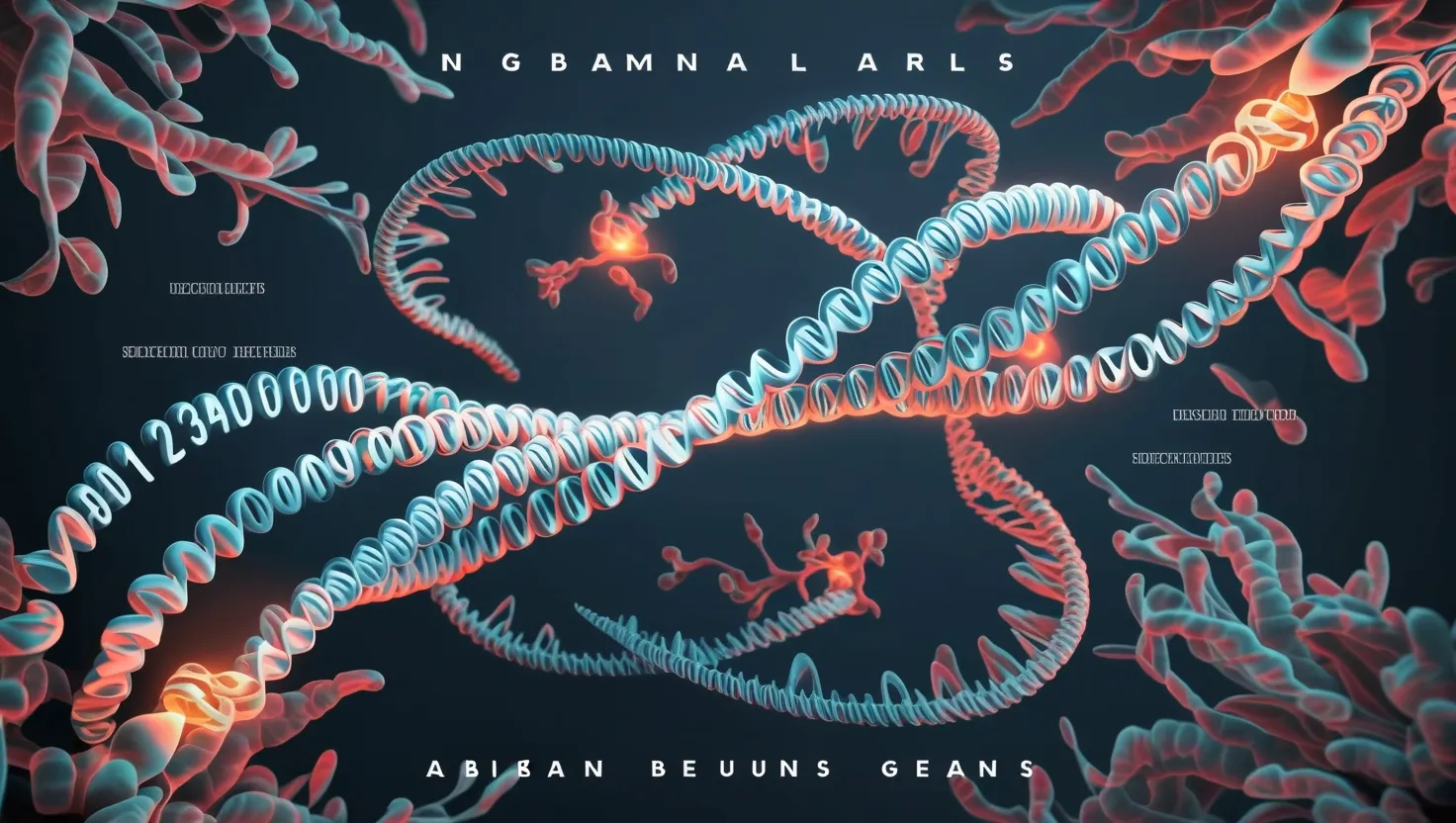
What Watson and Crick proposed was the double helix: two long strands of DNA wound around each other like a twisted ladder. The rungs of the ladder are pairs of chemical bases — adenine always pairs with thymine, and guanine always pairs with cytosine. This is not an arbitrary arrangement. The pairing rule means that if you know the sequence on one strand, you automatically know the sequence on the other.
That one insight explained how DNA could copy itself. Before cell division, the two strands unzip, and each strand serves as a template for a new partner strand. Life copies its own instructions every single time a cell divides — trillions of times in your body, with remarkable accuracy.
“The secret of life is base pairing.” — Francis Crick, reportedly said at the Eagle pub in Cambridge on the day of the discovery
The structure didn’t just explain copying. It explained storage. The sequence of those bases — in any order, across three billion positions in human DNA — is the information. Like letters in a sentence, the order determines the meaning. A four-letter alphabet, arranged in varying sequences, encodes every protein your body has ever made.
Knowing that DNA stores information is one thing. Reading it is another. In the 1960s, a quiet and relatively unknown scientist named Marshall Nirenberg cracked what researchers called “the genetic code” — the translation system between DNA and proteins.
Here’s the basic problem he solved. DNA is written in a four-letter alphabet: A, T, G, and C. Proteins are built from twenty different amino acids. How does a four-letter code specify twenty different things? The answer: triplets. Every three bases — called a codon — specifies one amino acid. Four bases taken three at a time gives 64 possible combinations, more than enough to cover twenty amino acids with room to spare.
What nobody expected was this: the code is almost identical across every living thing on Earth. The codon that tells a bacterium to add a specific amino acid tells a human cell the same thing. From yeast to elephants to sequoia trees, life uses the same dictionary. That’s not coincidence — it’s evidence that all life on Earth shares a single ancient ancestor, and that this code was locked in so early, and worked so well, that evolution never changed it.
Think about what that means. The language written in your DNA is the same language written in a mushroom, a shark, and a blade of grass. You are all reading from the same manual.
Even after scientists knew the structure of DNA and how to read its code, they still had no way to cut it, move pieces around, or study specific sections. DNA is an enormous molecule. Working with it was like trying to read a single sentence buried in a library with no index.
The discovery that changed this came not from a genetics lab, but from the study of bacteria. Researchers in the late 1960s noticed that bacteria had a defense mechanism against viruses. They produced proteins that could recognize a specific short sequence of DNA and cut it at that exact spot. These proteins — called restriction enzymes — were essentially molecular scissors with built-in recognition software.
In 1973, Herbert Boyer and Stanley Cohen realized they could use these scissors to cut DNA from two different organisms and join the pieces together. They created the first recombinant DNA molecule — a hybrid piece of genetic material that had never existed in nature. The implications landed fast.
“Science is the art of the soluble.” — Peter Medawar
Within a few years, scientists inserted the human insulin gene into bacteria, which then produced human insulin at scale. Before this, diabetics depended on insulin extracted from pig and cow pancreases. Recombinant DNA technology turned bacteria into tiny pharmaceutical factories. It also sparked fierce ethical debates that continue today — about who owns genes, what can be patented, and how far genetic engineering should go.
What would you change in your own genome if you could? It’s not a hypothetical anymore.
If Mendel gave us the rules, Watson and Crick gave us the structure, Nirenberg gave us the code, and restriction enzymes gave us the scissors, then the Human Genome Project gave us the complete text.
Completed in 2003 after 13 years and roughly $3 billion, the project mapped all three billion base pairs of human DNA and identified around 20,000 protein-coding genes. One of the most surprising findings was how few genes humans have. A rice plant has more. The number of genes turned out to be a poor measure of complexity — what matters is how those genes are regulated and combined.
The project also revealed something quietly humbling. Protein-coding genes make up only about 1.5% of human DNA. The rest was initially called “junk DNA.” That label turned out to be wrong. Much of it regulates when and how genes switch on and off, a field called epigenetics that is now one of the most active areas of biology.
The genome also told stories about history. By comparing sequences across human populations, geneticists mapped ancient migration routes, confirmed our shared ancestry with Neanderthals, and showed that all modern humans descend from populations in Africa. Your DNA carries a record of every ancestor who ever lived and died before you.
“Equipped with his five senses, man explores the universe around him and calls the adventure Science.” — Edwin Hubble
The downstream effects of the project continue to grow. Genetic testing for disease risk, pharmacogenomics (tailoring drugs to your specific genetic profile), and CRISPR gene editing all trace back to the foundation the Human Genome Project built. Personalized medicine — the idea that your treatment should match your biology — is now a clinical reality in oncology and rare disease management.
What connects all five of these discoveries is not just the science itself, but the fact that each one was built on the previous one. Mendel’s patterns needed a molecular explanation, which Watson and Crick provided. The structure needed to be read, which Nirenberg deciphered. The code needed to be cut and rearranged, which restriction enzymes made possible. And once all those tools existed, the Human Genome Project could read the entire instruction manual.
Genetics did not arrive fully formed. It accumulated. It stumbled. It was ignored, contested, stolen from, and misused. But across 150 years, a species that once had no idea why children look like their parents can now read its own genetic code, edit it with precision, and use it to predict and prevent disease.
The blueprint was always there. We simply had to learn how to read it.