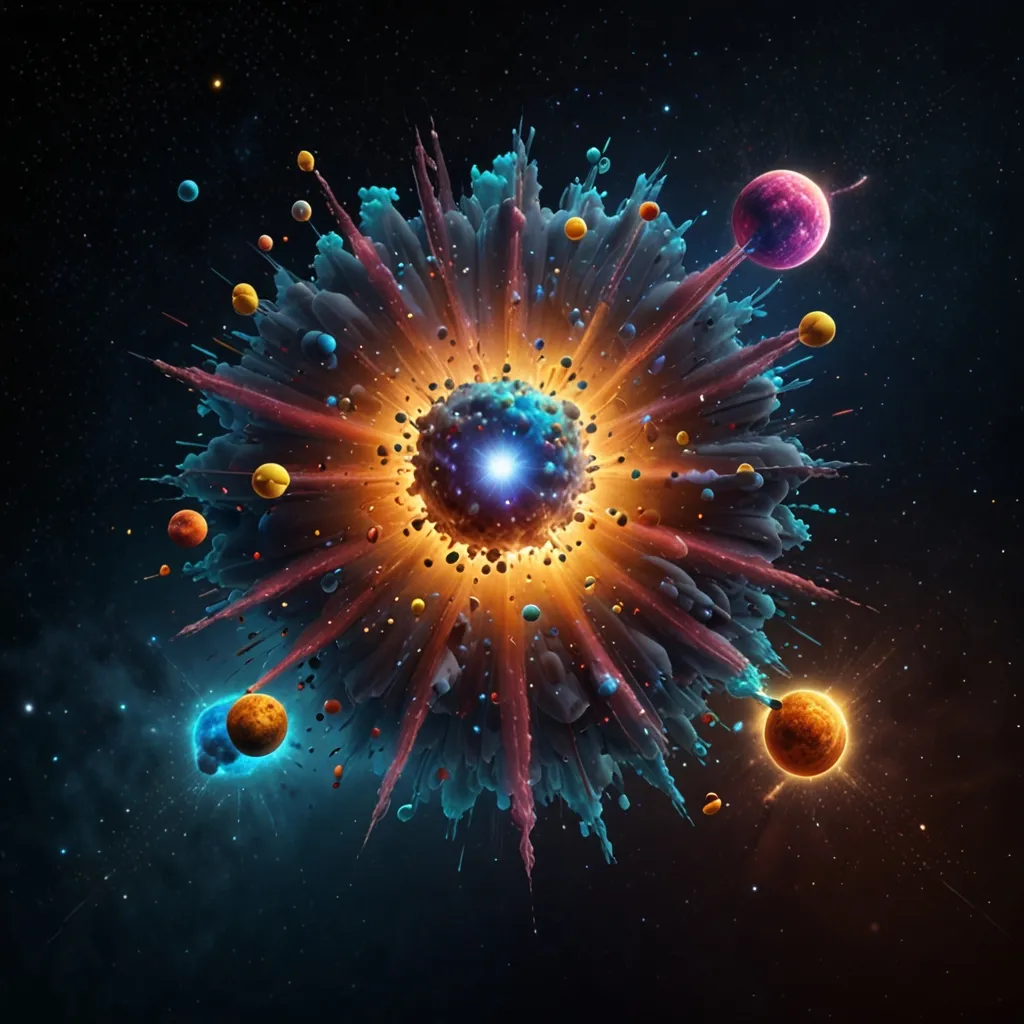
Everything you see around you started with the Big Bang, an unimaginably massive explosion from an infinitesimally small point known as a singularity. This explosion was pure energy, and naturally, we might look for its epicenter, its starting point. So, if the universe began with this colossal explosion, where is the center of the universe? The answer might surprise you: there is no single center—there are infinite centers.
The Big Bang wasn’t an explosion in space; it was an explosion of space itself. Imagine for a moment a balloon. If you think of the two-dimensional surface of the balloon as representing the three-dimensional space of our universe, you can start to visualize this concept. Only the balloon’s surface is our universe; the air inside doesn’t count. The galaxies and points in space we observe are akin to points on this balloon.
Now, picture inflating the balloon. Every point on it moves away from every other point. If you were located on any of these points, you’d think you were at the center of the universe because everything else appears to be moving away from you. This holds true no matter where you are on the balloon’s surface. As the balloon expands, every point appears to be the center from its own perspective.
This is exactly what we observe in the universe—everything is moving away from us. So, on the surface of the balloon, there is no unique center, or every point can be considered the center because of the uniform expansion.
Therefore, the next time someone says, “You’re not the center of the universe,” you can confidently reply, “Actually, I am,” and have science on your side.