Can a Laser Dot Really Outrace Light on the Moon?
Breaking Light Speed: The Illusion of Faster-than-Light Magic
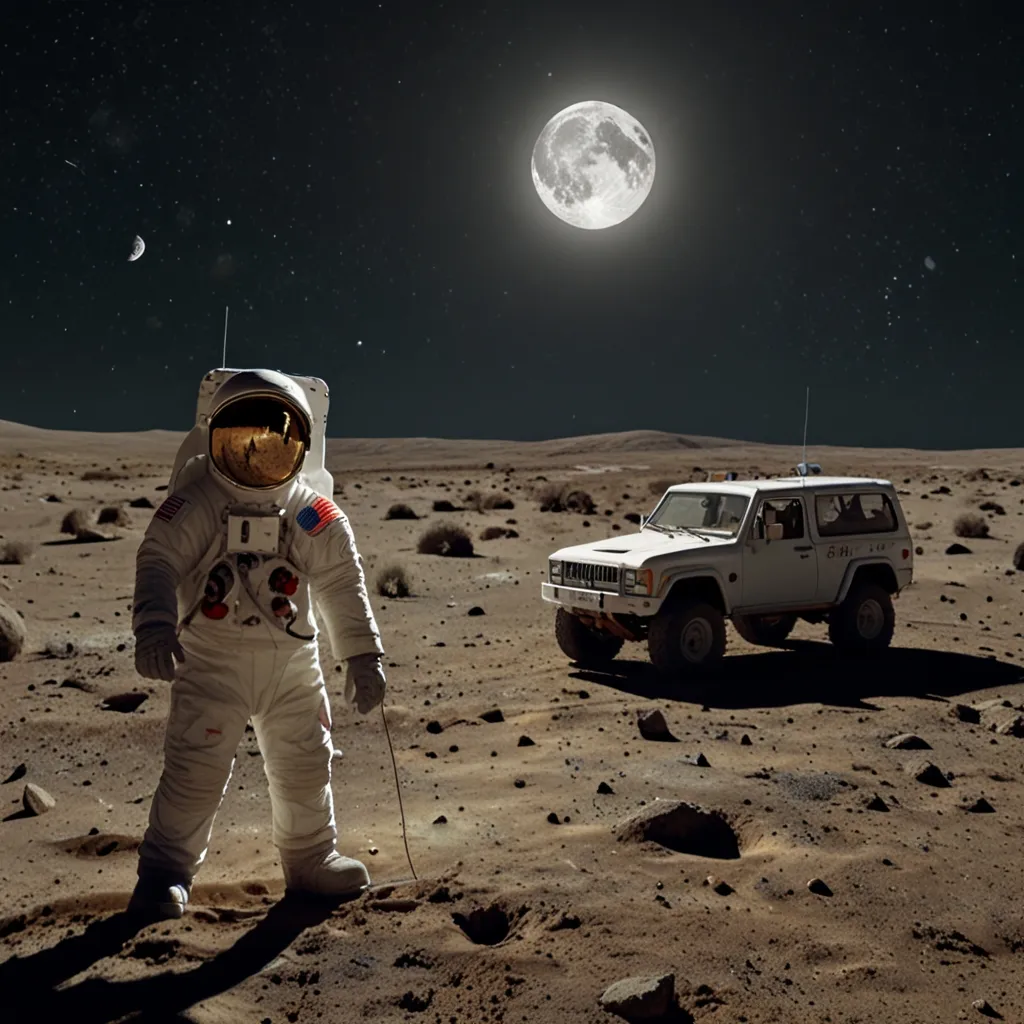
Imagine having a super powerful laser pointer. On a clear night, if you point it at the moon, you’ll see the dot appear there in just a bit over a second. It’s like magic! Now, let’s take this up a notch. Attach your laser pointer to a spinning device capable of doing 100 spins per second. You’ll find that the laser dot races around the moon’s surface much faster than the speed of light. But how could that be?
We’ve always believed nothing moves faster than light. But in this case, the dot zipping around isn’t a single photon moving that fast. Instead, different photons from your laser reach the moon at the speed of light, creating an illusion that the dot itself is moving faster.
Now, imagine astronauts on the moon trying to interact with the laser dot. They wouldn’t be able to use it for faster-than-light communication. Any attempt to send a message back to you on Earth would still be limited by the speed of light.
The lesson here is quite profound. While some “things” can seem to move faster than light, the universe still maintains a speed limit on communication and causality. This means no event can cause an effect instantly across the universe.
So, why does the universe have this speed limit? It’s tied to how forces work. Quantum field theory tells us that particles are disturbances in fields. Forces come from these field disturbances, and the speed at which these disturbances move is the maximum speed for communication. Light, being massless, travels at this speed, making it the cosmic speed limit.
Einstein’s theory of special relativity, established in 1905, changed everything by introducing two crucial postulates: all physical laws are identical for every non-accelerating observer, and the speed of light in a vacuum is constant regardless of the light source’s motion. This second postulate revolutionized our understanding of time and space.
To really grasp this, picture an observer switching on a flashlight just as someone on a fast-moving train does the same. Both will see light moving at the same speed. This constancy made clear that time changes based on the observer’s speed and direction, shredding old concepts of absolute time.
Now, let’s toy with the idea that light speed is infinite. This twist would break Einstein’s theories and lead to a universe where light and electromagnetic signals couldn’t exist, as they rely on finite speed to propagate.
Sticking with special relativity, imagine Alice on Earth and Bob on a rocket moving near light speed toward Proxima Centauri. Their clocks, synchronized at departure, would tick at different rates due to their relative speeds. Alice sees Bob’s clock slow, and vice versa. Despite these differences, neither can send messages faster than light without busting causality and spawning paradoxes.
If Alice sent a faster-than-light signal and Bob replied instantly, Alice might receive Bob’s reply before even sending her original message. This backward flow of information defies causality, creating chaotic outcomes and impossible scenarios like the notorious grandfather paradox.
Ultimately, the universe enforces a consistent law: objects and observers in motion experience time differently, and no piece of information can outpace light. Despite what sci-fi dreams of warp speeds and quantum drives tell us, our current understanding of physics rules them out.
Perhaps one day, a new Einstein will find a loophole, keeping the dream alive. But for now, the speed of light reigns supreme in our cosmic ballet.