Understanding nuclear physics doesn’t make you a physicist overnight, but grasping a few essential concepts can make you feel like a superstar at your next social gathering. Let’s break it down.
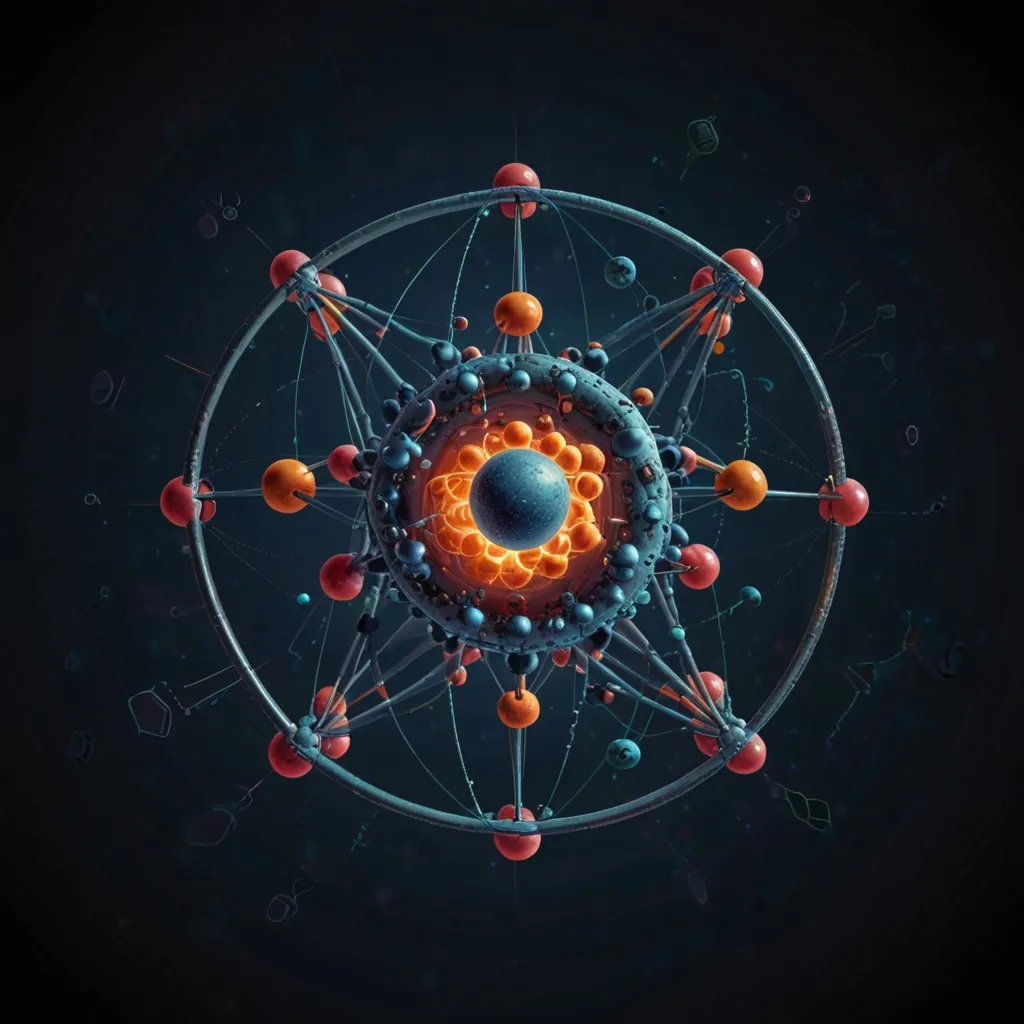
At the heart of any atom is its nucleus, surrounded by a cloud of electrons. The nucleus itself is composed of protons and neutrons, collectively known as nucleons. Despite the fact that like charges repel, protons stay together in the nucleus thanks to the strong nuclear force. This force is a hundred times stronger than the electromagnetic force but only acts over extremely short distances.
Think of it like this: Proton repulsion is huge, around 60 newtons, which is about 12 pounds of force. But the strong nuclear force, acting like super-strong velcro, keeps the protons and neutrons bound tightly when they’re close enough.
But there’s a catch. As the nucleus grows larger, the strong nuclear force’s effectiveness weakens because it only operates at short distances. In contrast, the electromagnetic force’s repulsive effect grows as more protons are added. This is why the heaviest stable element is lead, which has 82 protons.
Protons define an element’s identity and properties, while neutrons can vary, giving rise to isotopes. The balance between protons and neutrons is crucial for nuclear stability. Neutrons in a nucleus remain stable, but if they are free, they decay into protons, electrons, and antineutrinos quickly.
Large nuclei are prone to alpha decay if they have too many protons and neutrons. This decay produces alpha particles, essentially helium nuclei, that can tunnel their way out of the nucleus due to quantum effects. Beta decay occurs when a neutron decays into a proton within an unstable nucleus, releasing electrons and antineutrinos, while gamma decay involves the emission of high-energy photons from excited nuclei.
Radioactive decay is not always straightforward. Each radioactive substance has a half-life, the time it takes for half of the atoms in a sample to decay. It’s a statistical measure, making it unpredictable which specific atoms will decay over time.
The concept of nuclear fission is fundamental to nuclear power and weapons. When certain isotopes like uranium-235 are struck by a neutron, they split into smaller nuclei and release more neutrons, triggering a chain reaction. On the flip side, nuclear fusion involves fusing small nuclei, like hydrogen, to form heavier nuclei, releasing immense energy, which powers the stars.
The sun’s energy, for instance, is produced by hydrogen fusion. Unlike man-made hydrogen bombs, which require immense temperatures to achieve fusion, the sun’s massive gravitational pressure allows fusion to occur at comparatively lower temperatures.
So, with these core insights, you’re now equipped to understand the fascinating world of nuclear physics and to impress your friends at dinner parties. Remember to use this knowledge wisely and for the greater good.