Did My Basketball Robot Just Change the Game?
When AI Promises Ring Hollow, Trust Engineers to Make the Dunk
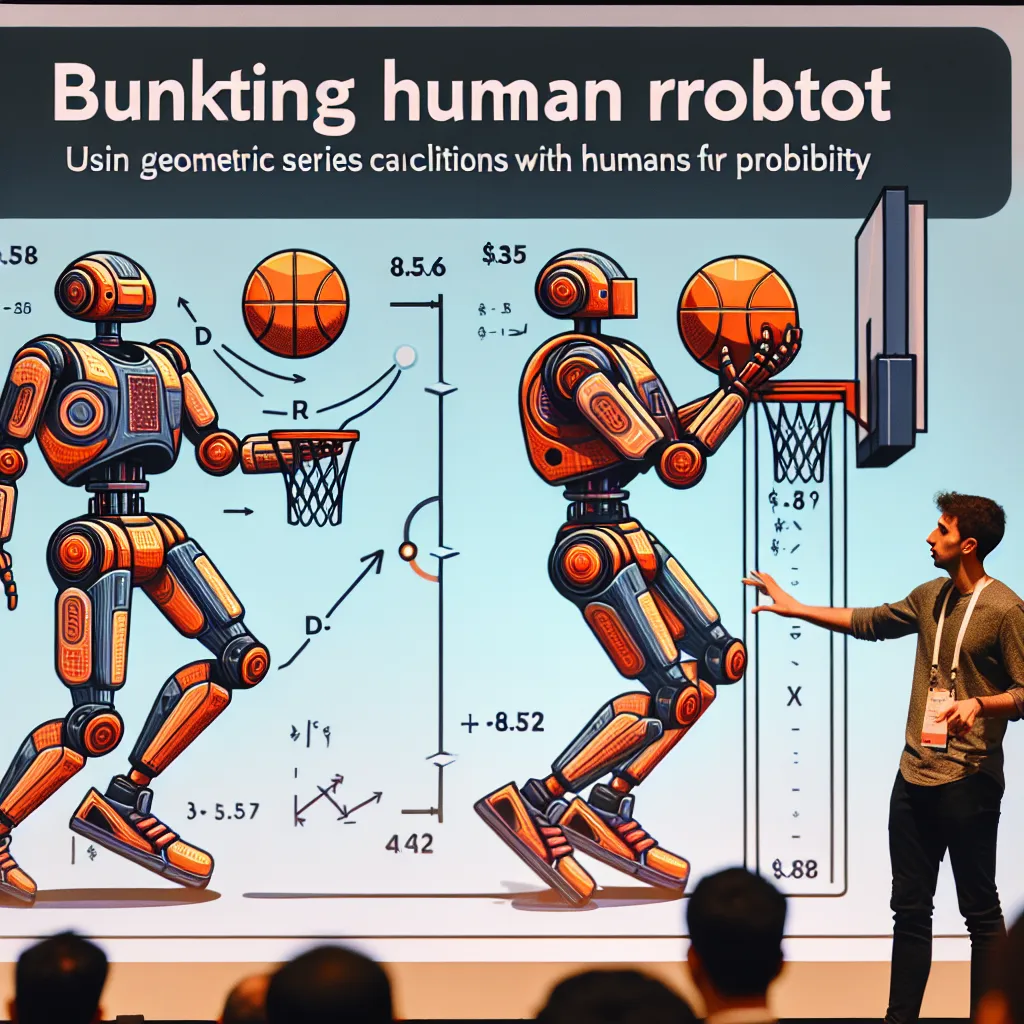
I’d spent months designing a basketball-playing robot, the Dunk-O-Matic. I was stoked to show it off at the big Sportecha Conference. But then I saw an ad for the event: “Watch the Dunk-O-Matic play against humans and adjust its skills for a fair game!” This wasn’t in the plan. I designed a robot that took turns shooting with a human, sometimes scoring, sometimes not. There was no talk of it balancing its performance based on the opponent.
It seemed like the CEO skimmed an AI article and overpromised, setting me up for a public disaster. Thank goodness, I had installed a feature to adjust the robot’s shooting probability. We also had data on each potential demo participant, including their basket-making probabilities.
In each game, the human shot first, then the robot, alternating until someone made a basket to win. I could tweak the Dunk-O-Matic’s probability between rounds. The million-dollar question was: What probability should I set for each opponent so the human had a 50% chance of winning?
One might guess to set the robot’s probability (q) equal to the human’s (p). But that’d overlook the edge of shooting first. If both probabilities were 100%, the first shooter would always win, despite equal skills. A deeper dive with geometric series was needed.
Geometric series are sums of numbers where each number is a fixed ratio of the previous one. If the ratio (r) is less than 1, the series sums to a finite number. The sum is the first number (a) divided by 1-r.
How did that help with the robot? The human made the first shot with a probability of p. Winning on their second attempt meant both missed the first round, which had the probability (1-p) and (1-q). The combined probability for this was (1-p) * (1-q). Multiplying these probabilities leads to an infinite geometric series.
To make the game fair, the sum of the human’s win probabilities needed to be 1/2. Solving the series sum with algebra, q turned out to be p / (1-p). If p was more than 50%, q would be over 1, which is impossible. For probabilities over 50%, an even game was out of reach because humans would have more than a 50% chance of winning from the start.
The robot’s win probability was also a geometric series. For the robot to win, the sequence involved double misses, a human miss, and then a robot score. Aligning the robot’s winning chances with the human’s, q had to be p / (1-p). Each round restarted the game equally if the probabilities matched.
The demo went smoothly, but honesty pulled at me. I took the stage and clarified our CEO’s false promises and my quick solution. The bad press aimed at my company surprisingly worked in my favor. The volunteers turned out to own a friendlier robotics company, leading to some IP litigation, and eventually, I found a healthier job and a regular spot on a pickup basketball team.