Did Our Universe Really Emerge From Absolute Nothingness?
From Ancient Beliefs to Quantum Realities: Unraveling the Origins of the Universe
Ancient Greek cosmologists, like Parmenides, believed that nothing comes from nothing. This mirrors the modern law of conservation of energy, asserting that no new energy can be created. Yet, this notion faces a challenge when considering the origins of the universe—how could it come from “nothing”? With the advent of quantum physics and relativity, we now understand that the creation of something from truly nothing is indeed possible. How does this work?
There is strong evidence that our universe began about 13.8 billion years ago with the Big Bang. But what was there before the Big Bang? And how did the universe come from nothing? The flaw in Parmenides’ argument is linked to the nature of gravity and energy. Gravity has negative energy while matter has positive energy. In a closed universe, a spontaneous division of zero energy into equal amounts of positive and negative energy doesn’t break any conservation laws. In quantum mechanics, anything not forbidden by these laws has a probability of occurring, even if it’s small. Thus, in a quantum universe, the occurrence of such division is not only possible but inevitable.
So, our universe could indeed form from a “vacuum.” Now, a vacuum in physics isn’t nothing—it’s filled with virtual particles that appear and vanish quickly, possessing weight, energy, and pressure. This isn’t the same as “nothing,” which leads us to a more profound question: can a universe come from truly nothing?
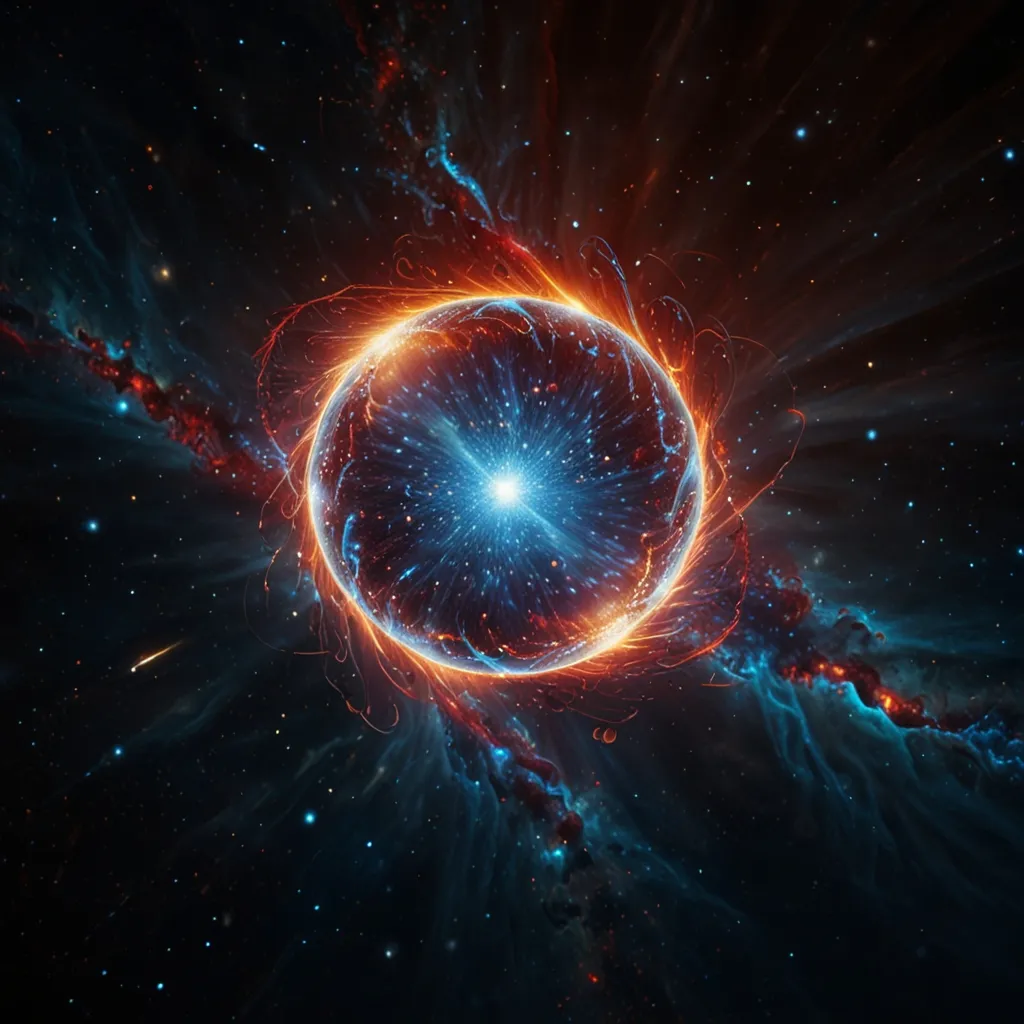
Considering our expanding universe, Einstein’s equations describe it as either expanding or contracting. The Big Bang, occurring from a finite-sized universe, involved incredibly high energies. In 1979, Alan Guth introduced the concept of cosmic inflation, explaining how a small region containing a unique state of matter could expand rapidly due to repulsive gravity. This high-energy state allowed for a brief but explosive expansion, causing the Big Bang.
Thus, our universe began from a finite state with high energy. But what about before that? How did a zero-sized universe become this finite-sized universe? In 1984, physicist Alexander Vilenkin proposed the theory of quantum creation, suggesting that a zero-sized universe could overcome an energy barrier through quantum tunneling—a well-established phenomenon in quantum mechanics. This theory shows a nonzero probability for a zero-sized universe to transition to a finite size, which could then trigger the Big Bang through cosmic inflation.
Quantum mechanics enables the transition from a zero-sized universe to a finite one, and general relativity takes over from the Big Bang to the present. What started all this? Quantum physics implies events don’t always need a cause, just a probability.
Vilenkin’s theory remains unproven, but if true, it suggests our universe emerged from ultimate nothingness. Even if we accept this, we must ask: where did the laws of quantum mechanics come from? These laws might exist independently of space and time, similar to mathematical truths like 2+2=4, which hold whether humans or the universe exist.
This brings us to a profound question: do these laws exist because they are inherent in reality, or is there something more? The search for these answers continues, inviting both scientific and philosophical inquiry.