science

What Happens When a Star Pushes Its Cosmic Limits?

Witness the Stellar Metamorphosis: From White Dwarfs to Neutron Stars in the Cosmos’ Fiery Forge

What Happens When a Star Pushes Its Cosmic Limits?

In the fascinating world of astrophysics, there’s a specific limit to how much mass a white dwarf star can sustain before undergoing a significant transformation. This limit, known as the Chandrasekhar limit, is named after the Indian-American physicist Subrahmanyan Chandrasekhar. He discovered that a white dwarf star could not possess more than about 1.4 times the mass of our Sun without collapsing.

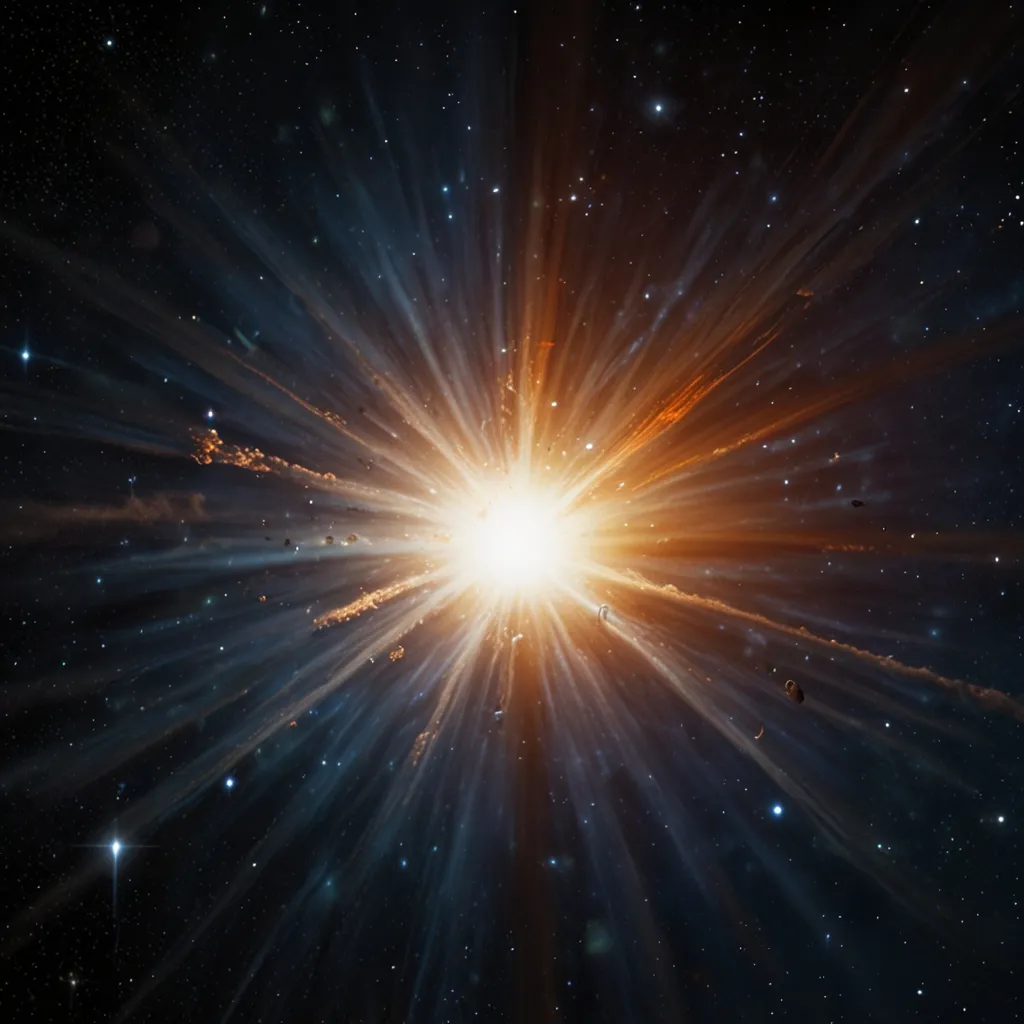
When a white dwarf surpasses this limit, the core temperatures escalate dramatically, soaring past 5 billion degrees Celsius. At these intense temperatures, gamma rays are produced, which have enough energy to break iron nuclei into helium nuclei, also known as alpha particles. This reaction further increases the temperature to an astonishing 100 billion degrees Celsius.

Under such extreme conditions, electrons begin to combine with protons in a process termed electron capture, resulting in the formation of neutrons and a release of neutrinos. By this point, the electrons are captured by the nucleus, forming a dense core of neutrons. The end result is a transformation from a white dwarf into a neutron star.

Neutron stars are incredibly dense – much denser than white dwarfs. While a white dwarf could be roughly the size of the Earth, a neutron star shrinks down to a mere 10 to 20 kilometers wide. This immense density and compact size make neutron stars some of the most fascinating objects in the universe.


Similar Posts
Blog Image
How Did Ancient Egyptians Tackle Decay and Taxed Mummies as Salted Fish?

Mummified Mysteries: The Ingenious, Gruesome Artistry of Ancient Egyptian Preservation

Blog Image
Biophysics: Bridging the Gap Between Biology and Physics

Biophysics merges physics and biology, unraveling life's mysteries from DNA to ecosystems. It drives medical innovations, environmental studies, and technological advancements, fostering interdisciplinary collaboration to solve complex biological puzzles and improve human life.

Blog Image
Neuroplasticity: Rewiring the Brain for Better Health and Performance

Neuroplasticity allows brain rewiring throughout life. Learn languages, play games, exercise, socialize, and try new experiences to boost brainpower, improve mood, and enhance cognitive function. Small, consistent efforts can yield significant results.

Blog Image
Journey of Light: How Sun's Fiery Core Powers Life Across the Universe

The cosmic ballet of fusion turns hydrogen into helium, creating life-giving sunlight and invisible neutrinos, perfectly balancing our universe's fiery energies.

Blog Image
Did Pompeii's Final Moments Reveal Secrets We've Only Just Discovered?

Lost Moments and Eternal Echoes: Life Interrupted by Vesuvius in Ancient Pompeii

Blog Image
Did a 17th-Century Nun Outshine Mexico’s Brightest Minds?

The Shining Beacon of Intellectual Defiance in Colonial Mexico