The Five Discoveries That Built Our Electrical World
I want to take you on a journey through five moments that changed everything about how we live. These weren’t flashy moments that made headlines for a day. They were quiet revolutions that fundamentally altered what it means to be human. Each breakthrough solved a problem that seemed unsolvable at the time, and each one opened doors to possibilities nobody had imagined.
When I think about electricity, I think about something invisible flowing through walls and wires, powering the device you’re reading this on right now. But that invisible force almost never happened. For most of human history, we didn’t know how to capture it, control it, or make it do anything useful. The people who figured it out weren’t superhuman geniuses in the conventional sense. They were stubborn experimenters who asked simple questions and refused to accept “impossible” as an answer.
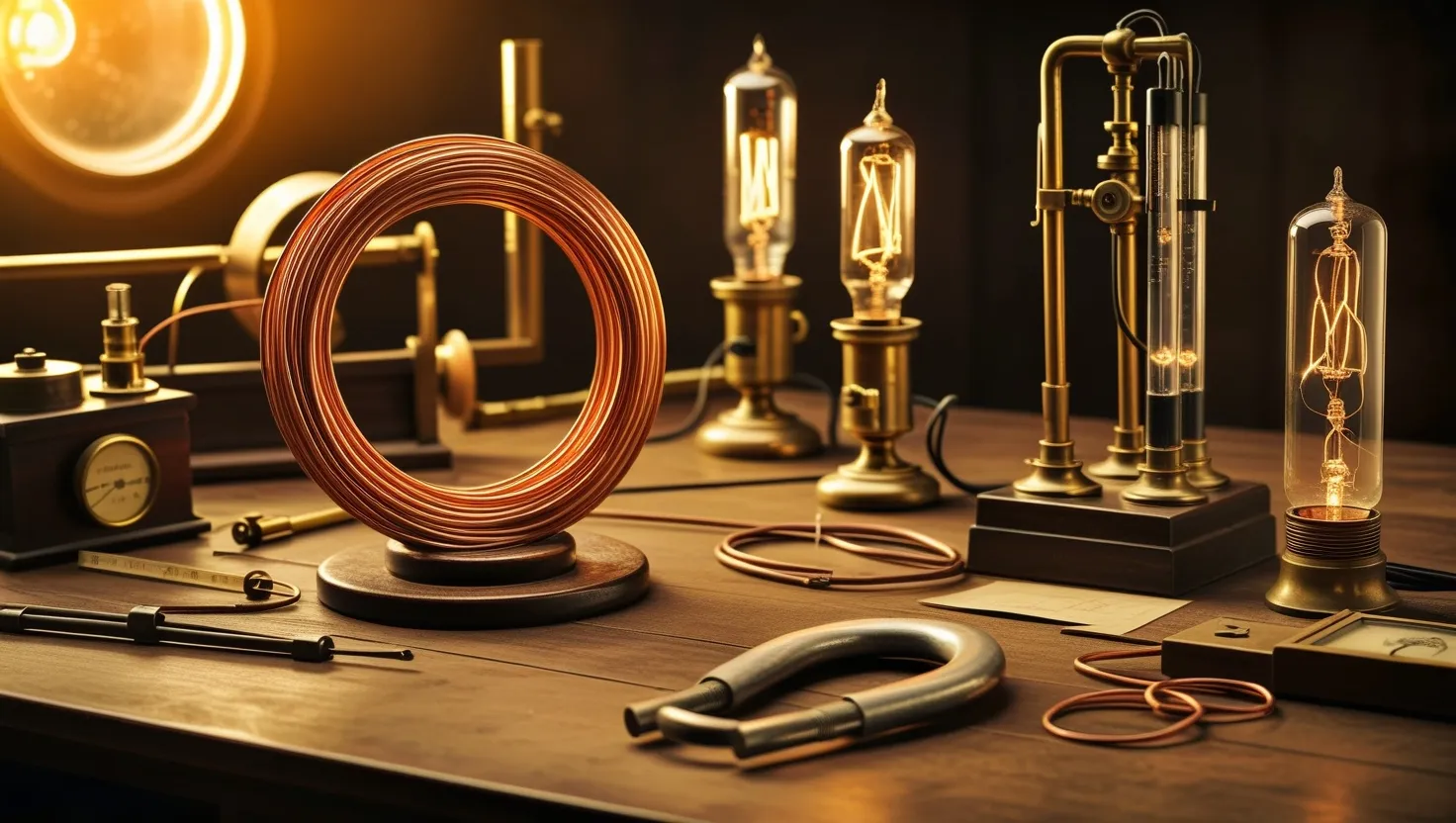
Let me start with a man named Michael Faraday. In 1831, he stood in a laboratory with a simple setup: a magnet, a wire coil, and a measuring device. He moved the magnet through the coil and watched something magical happen. The measuring device twitched. He had created electricity through motion. This wasn’t just a neat party trick. Faraday had discovered the fundamental principle that would power civilization. When you move a magnet near copper wire, electrical current flows. That’s it. That’s the entire foundation of modern power generation.
Why does this matter so much? Because before Faraday, electricity was just a curiosity. People could create static shocks or observe lightning. But making electricity reliably, in useful quantities, and on demand? That seemed like fantasy. Faraday showed that it was chemistry and physics, nothing mysterious at all. His discovery meant that any source of motion—wind turning a blade, water flowing downhill, steam expanding from heat—could become electricity. Suddenly, the problem wasn’t whether we could generate power. It was whether we could do it practically.
Think about your own life for a moment. How many times today have you relied on something powered by electric current? Your phone charging, your lights, your water heater, your car battery. All of those stem directly from what Faraday figured out nearly two centuries ago.
The second breakthrough came from a man who was just as curious but operating in a completely different way. Thomas Edison didn’t just invent the light bulb. That’s what most people think, and it’s slightly wrong. Dozens of inventors had created glowing wires before Edison. What Edison actually invented was something far more important: a complete system that worked reliably for regular people.
Edison’s genius lay in thinking like a businessman disguised as an engineer. He created a durable filament that didn’t burn out after five minutes. He developed generators powerful enough to supply multiple buildings. He designed parallel wiring so that switching off one light didn’t kill the power to everything else. And then he built the Pearl Street Station in New York in 1882, the world’s first central power plant. This wasn’t just a generator. It was the prototype for every utility company that would follow.
Edison proved that electricity wasn’t just scientifically possible. It was commercially viable. People would pay for it. Businesses would depend on it. Cities would organize themselves around it. Before Edison’s Pearl Street Station, electricity was a laboratory curiosity. After it, electricity became infrastructure.
“The present is theirs; the future, for which I really worked, is mine.” Edison said that, and he meant it. He wasn’t interested in being the smartest person in the room. He was interested in building something that would outlast him by generations.
Here’s an interesting question: If Edison had lived today, do you think he’d be building power plants or writing software? I think the answer tells us something important about how differently we see progress now compared to then.
The third breakthrough arrived a few years after Edison’s Pearl Street Station took power, and it came from a man who thought Edison was wrong about something fundamental. Nikola Tesla believed in alternating current. Edison believed in direct current. This wasn’t a friendly disagreement. It was bitter and personal and shaped the entire electrical infrastructure of the modern world.
Why did it matter so much? Picture this: Edison’s direct current worked beautifully in New York City. But as soon as you tried to send it more than a mile or two away, something frustrating happened. The power just… faded. The electricity lost strength as it traveled. It was like trying to hear someone shouting from across a field. The farther away they are, the quieter they sound, no matter how loud they shout.
Tesla’s alternating current solved this problem in an elegant way. You could take the current, step it up to incredibly high voltages, send it long distances on thin wires without losing power, and then step it back down to safe levels at the destination. It was like using a relay of runners passing a baton instead of one person trying to throw something across the entire field.
This might sound technical, but its consequence was massive. Suddenly, you didn’t need a power plant in every city. You could build one plant near a coal mine or waterfall and serve a whole region. Power generation became a large-scale business instead of a local operation. The electrical grid was born from this insight. Tesla won that war, though Edison got most of the fame.
The fourth breakthrough might seem smaller than the first three, but I’d argue it changed our lives more directly than all the others. In 1947, three physicists at Bell Laboratories created something called a transistor. If you’ve ever wondered why your phone fits in your pocket while computers from the 1950s filled entire rooms, the transistor is why.
Before the transistor, electronic devices relied on vacuum tubes. These were glass bulbs with special properties that could amplify electrical signals. They worked well, but they had serious limitations. They were big. They needed a lot of power to operate. They generated tremendous heat. They burned out frequently. A computer from the 1950s might contain thousands of vacuum tubes, require an entire room to house them, and produce enough heat that you had to install special cooling systems.
The transistor was a tiny crystal of silicon or germanium with special properties. It could do everything a vacuum tube could do, but in a space the size of a grain of rice. It needed almost no power. It didn’t generate heat. It lasted for decades. From that moment onward, electronics could get smaller and smaller while getting more powerful and more efficient.
This is where we hit the turning point in human history, I think. Before the transistor, technology was getting bigger and more centralized. After the transistor, technology started getting smaller and more personal. Your phone contains billions of transistors. Your computer, your watch, your car, your refrigerator—all of them are built on principles that trace directly back to that discovery in 1947.
Here’s something that might surprise you: when transistors were first invented, many electronics companies weren’t interested. Vacuum tubes were their business. Why would they want to replace them? This is a pattern that repeats throughout history. The organization that dominates with the old technology is often the last to adopt the new one.
The fifth breakthrough is the strangest and most misunderstood of all. In 1911, a physicist named Heike Kamerlingh Onnes was experimenting with mercury at temperatures so cold that the mercury became a solid. At about 4 degrees above absolute zero, something absolutely bizarre happened. The electrical resistance of the mercury vanished. Completely. Electricity flowed through it with zero loss of energy.
This phenomenon is called superconductivity, and it seems like it should be the most useful discovery in electrical history. Imagine power lines that lose no energy to heat. Imagine electromagnets that are infinitely powerful because they could run forever without burning out. Imagine machines of incredible precision.
The problem is that superconductivity only works at temperatures that are fiendishly difficult and expensive to maintain. You need liquid nitrogen or liquid helium. The technology has found uses—MRI machines in hospitals use superconducting magnets, for example—but it hasn’t revolutionized everyday electricity the way Faraday or Tesla imagined it might. Yet the discovery led to entire new fields of physics and engineering. It showed us that the universe has stranger properties than we imagined.
Now, here’s what I find most interesting about these five breakthroughs: none of them solved a problem perfectly. Each one was incomplete, limited, or created new problems that future generations had to solve. Faraday’s principle needed Edison’s system design. Edison’s system couldn’t scale until Tesla improved it. The electrical infrastructure worked beautifully, but then we needed transistors to make the next leap forward. Transistors worked, but superconductivity showed us that physics had even stranger tricks hidden inside.
This pattern keeps repeating in technology. We solve one problem and create the conditions for the next one. We build better power systems, and suddenly we need tiny, efficient electronics to control them. We create computers, and suddenly we need wireless power transfer to eliminate cables. We build smart grids, and suddenly we need artificial intelligence to manage them efficiently.
I think the real lesson isn’t about any one discovery. It’s about the process itself. Every single one of these breakthroughs came from someone looking at a problem and refusing to accept that it couldn’t be solved. They didn’t have special equipment. They didn’t have massive budgets or computer simulations. They had curiosity, persistence, and the willingness to be wrong many times before getting it right.
When you use electricity today, you’re benefiting from the work of hundreds of people across multiple centuries. You’re standing on a foundation built by Faraday and Edison and Tesla and the Bell Labs physicists and countless others whose names we’ll never know. That’s what makes this history so powerful. It reminds us that the modern world isn’t magic. It’s the result of human ingenuity applied to real problems.[1][2][3][4]
What problem are you facing today that future generations might solve with a breakthrough we can’t yet imagine?