Can We Really Unravel the Universe's Blueprint with the Standard Model?
Decoding the Universe: The Elegance of the Standard Model Without Gravity
When discussing the frontier of physics, many have heard of the elusive “theory of everything.” This theoretical framework aims to cohesively explain all particles and phenomena in the universe. It’s the bridge between quantum mechanics and general relativity, often described as revealing the very “mind of God.” Stephen Hawking’s famous remark on this has spurred some physicists to dub it the “God equation.”
However, we shouldn’t overlook the remarkable progress already made with the Standard Model of particle physics. While not a complete theory of everything, this model is the most accurate one we’ve had to date. It details all known fundamental particles and three of the four fundamental forces: electromagnetism, and the strong and weak interactions. The one missing piece? Gravity.
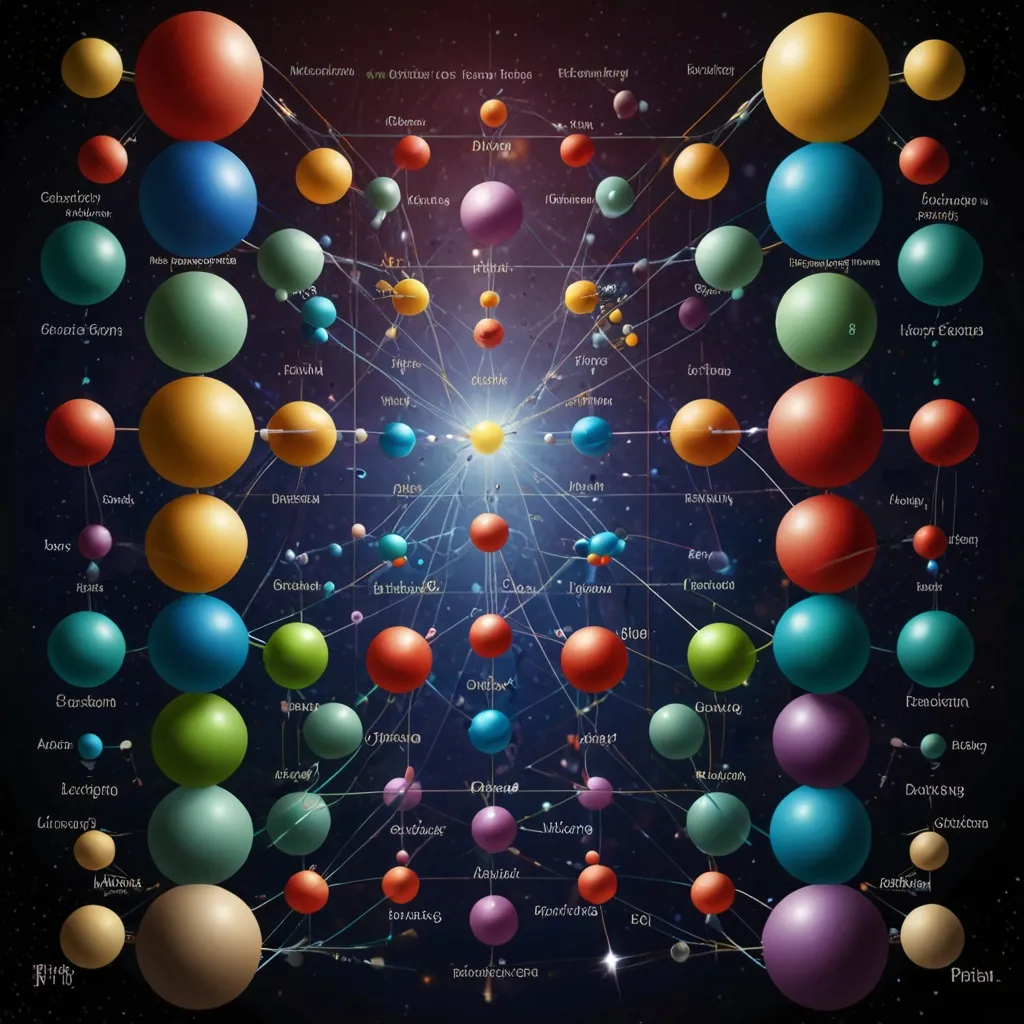
Don’t be tricked by its relatively simple chart; behind it lies intricate math that takes years of advanced study to fully grasp. Hundreds of scientists have contributed over decades to develop this robust framework, which can be summarized by the Standard Model Lagrangian: a powerful equation encapsulating the pinnacle of human knowledge about the universe.
To break it down, on the left side of the Standard Model chart, we have fermions, the building blocks of all matter. On the right side, we have bosons, responsible for the forces that act upon matter, including the unique Higgs boson, which imparts mass to particles. Familiar matter is composed of just a few of these particles: up and down quarks, electrons, and the nearly massless electron neutrino, produced in stellar fusion.
Rare particles, often created inside particle accelerators like the Large Hadron Collider or through cosmic rays, decay almost instantly. Yet, they provide crucial insights into the universe’s workings. Fermions split into leptons and quarks, with quarks interacting through the strong nuclear force, binding atomic nuclei, while leptons do not.
Bosons are force carriers: gluons handle the strong force, various W and Z bosons the weak force, and photons the electromagnetic force. The Higgs boson stands apart, giving mass to particles via the Higgs field. Despite gravity’s absence from this model, it remains the cornerstone of modern physics.
The quantum field theory underpins the Standard Model, which sees particles as excitations in fields, like tiny waves instead of marbles. This framework transforms into Feynman diagrams, visual representations of particle interactions made intuitive.
Within the Standard Model’s Lagrangian, complex terms describe the different ways particles and forces interact. Terms within the Lagrangian account for various fields: electromagnetic, weak, and strong forces, represented by different matrices.
The Higgs mechanism involves specific terms that explain how particles acquire mass, particularly the W and Z bosons. The Higgs field has a non-zero minimum value, essential for mass generation.
The equation also factors in antimatter, ensuring that our mathematical understanding accounts for both matter and its counterpart. This highlights the model’s comprehensiveness, even if it’s not the final theory of everything.
Despite its gaps—like the exclusion of gravity and no explanation for dark matter and dark energy—the Standard Model represents a monumental leap in our understanding of the universe. It’s a testament to human ingenuity that, in less than a century, we’ve deciphered so much about our cosmos once deemed incomprehensible.
Though the quest for a complete theory continues, the Standard Model remains an extraordinary achievement, framing today’s scientific understanding and inspiring further exploration into the mysteries of the universe.