Could Dark Matter Be Heating Up Faraway Planets?
A Galactic Heatwave: Exploring Dark Matter’s Fiery Influence on Exoplanets
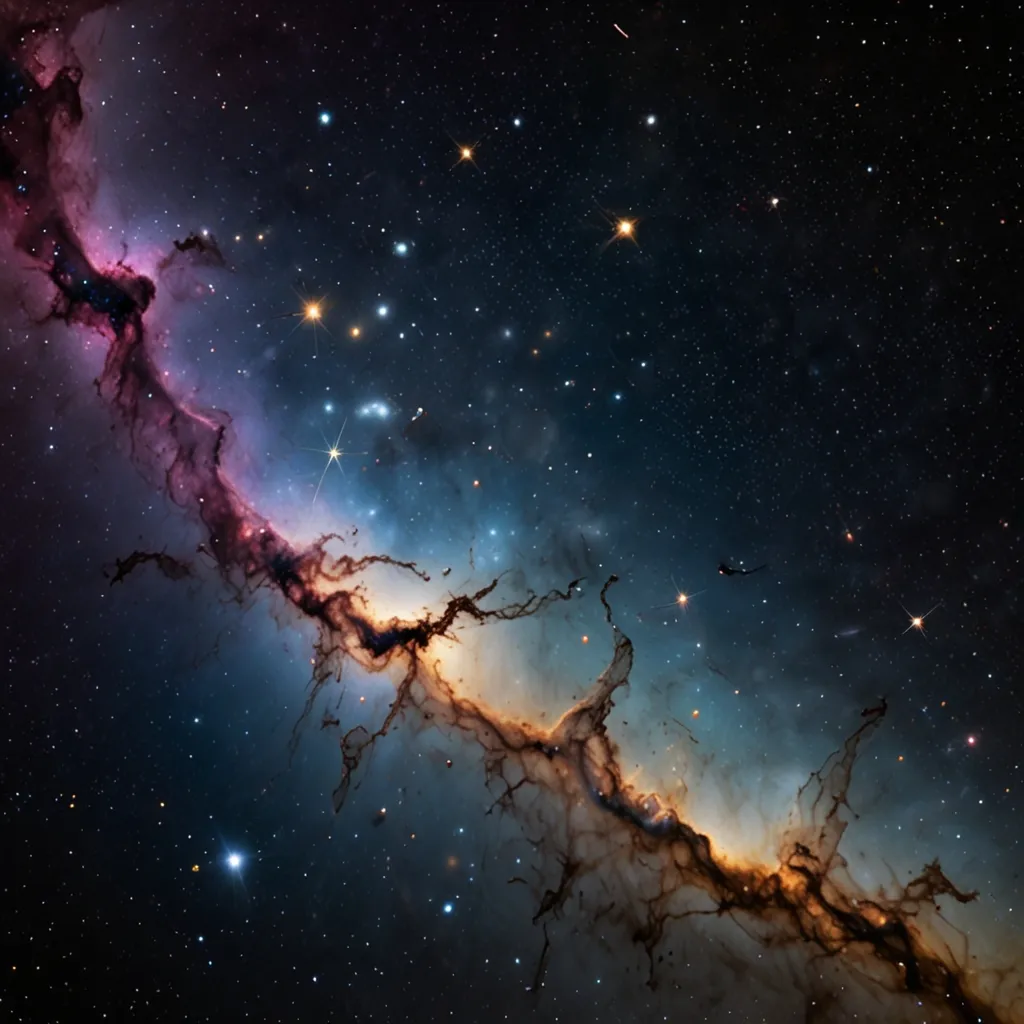
Exploring the Mysteries of Dark Matter in Our Universe
Dark matter is one of the most intriguing subjects in astrophysics. It constitutes roughly 82% of all matter in the universe, yet eludes direct detection. While invisible to us, its presence can be inferred from the gravitational effects on galaxies. The stars on the outer edges of galaxies like the Milky Way rotate faster than they should if only visible matter were present. This suggests an unseen mass, providing the gravitational pull needed to hold these stars in place.
Scientists have proposed that dark matter might consist of weakly interacting massive particles (WIMPs). These particles are heavy and don’t interact with ordinary matter electromagnetically. Despite numerous efforts to detect them, whether by using liquid xenon baths, sensors, or even the Large Hadron Collider, WIMPs remain elusive.
However, a novel approach by physicists Rebecca Leanne from Stanford’s SLAC lab and Yuri Smirnov from Ohio State University brings new hope. Their research suggests that dark matter might heat exoplanets, which are planets outside our solar system. As exoplanets move through the dark matter halo of our galaxy, occasional particle collisions might capture and slow down dark matter particles. These particles eventually get trapped by the planet’s gravity, collide, and annihilate each other, releasing heat. This process could significantly raise the temperatures of these planets.
For instance, while we might expect distant exoplanets to be freezing, they could actually be broiling hot due to this dark matter heat. The team predicts that temperatures could soar to around 1000 Kelvin (about 700 degrees Celsius), compared to a mere 200 Kelvin without such dark matter interactions.
The key to confirming this theory would be finding a pattern. If exoplanets closer to the galaxy’s center (where dark matter density is higher) exhibit higher temperatures, it would be a strong indicator of dark matter’s influence. Larger exoplanets, particularly those more massive than Jupiter (referred to as super Jupiters), would be the best candidates for detecting this heat due to their ability to accumulate more dark matter.
To test this theory, scientists are eagerly anticipating the launch of the James Webb Space Telescope (JWST). Set to launch soon, JWST will be the most powerful space telescope, capable of detecting the infrared heat signatures of these exoplanets. This telescope could become a game-changer in our quest to understand dark matter.
In essence, we are on the verge of possibly solving one of the biggest cosmic mysteries. Dark matter has long fascinated scientists, and with the JWST’s advanced detection capabilities, we might finally uncover its secrets. The potential discoveries make this an exciting time for science enthusiasts.
Stay curious and keep watching the stars. The answers to the universe’s mysteries could be closer than we think.